Embroidered Polo Shirts for Small Business: The Complete Guide
Last reviewed: 15 September 2026 · Written and reviewed by the Xcel Print & Promotions team
Published: 15 September 2026
Embroidered polo shirts are one of the smartest uniform investments a small business can make. They’re smart enough for customer-facing work, tough enough for practical trades, and embroidery keeps your logo looking crisp wash after wash, far longer than printed alternatives on frequently-worn garments. If you’re ordering for the first time, this guide walks you through exactly what to think about before you spend a penny.
Why do small businesses choose embroidered polo shirts over printed ones?
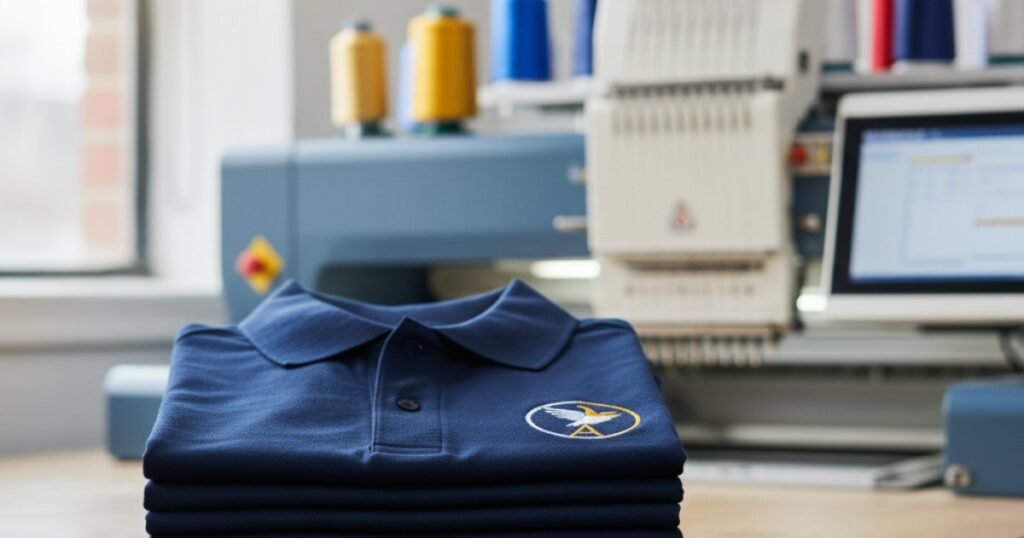
Both embroidery and printing have their place, but polo shirts are a case where embroidery wins for most small business applications. The stitched logo sits slightly raised from the fabric, giving it a premium, tactile feel that customers notice, it reads as established and professional rather than startup. More practically, embroidery doesn’t crack, peel or fade in the same way that printed decoration can after heavy commercial washing.
From what we see in our Haverhill workshop, trades and service businesses, plumbers, electricians, landscapers, cleaning companies, almost always choose embroidery for their polos. The garments get washed constantly, sometimes at higher temperatures, and the decoration simply has to keep up. A logo that looks tatty after six months does your brand more harm than no logo at all.
That said, printing absolutely has its advantages on polo shirts when you need photographic detail, a very large chest design, or a lower-cost option for a one-off event. We do both in-house, so we’ll always tell you honestly which route suits your brief. See our printing services if you want to compare.
What polo shirt fabric should a small business choose?
The fabric question trips people up more than almost anything else. Here’s a plain breakdown:
- 100% cotton piqué, breathable, comfortable, takes embroidery beautifully. Tends to shrink slightly if tumble-dried hot, so size up if your team does that. Great for hospitality, retail and office-facing roles.
- Polyester or performance fabric, moisture-wicking, quick-dry, very durable. Popular with trades and outdoor teams. Embroidery sits well on it but choose a tightly-woven version, very open weaves can pucker around the stitching.
- Poly-cotton blends (typically 65/35), the middle ground. Less shrinkage than pure cotton, still breathable, holds colour well. This is what many of the Uneek and Portwest polo ranges use, and it’s what we’d suggest for most small business uniforms where you want reliability without overthinking it.
Avoid very thin or very stretchy fabrics for your first embroidered order. They’re harder to stabilise during embroidery and the results are less predictable. Stick to a mid-weight (around 200-220 gsm) for a dependable outcome.
How do you choose the right colour for a branded polo shirt?
Match your brand, obviously, but think about practicality too. Light colours show dirt faster, which matters on a building site but is fine in a salon or letting agency. Dark colours (navy, black, bottle green) are unforgiving of pet hair and dust but hide general grime and tend to photograph well for your website and social media.
One thing we see regularly: businesses ordering white polo shirts because they look clean and neutral. White polos are fine, but embroidery on white carries a higher risk of the backing material (used to stabilise the embroidery) showing through very thin fabrics. On a quality mid-weight white polo it’s not a problem, but it’s worth mentioning so you know to ask.
If your brand colours are unusual, a particular shade of orange or teal, check the garment colour chart carefully before ordering. Garment manufacturers use their own colour names and the reality doesn’t always match a screen. We can send physical colour swatches for larger orders; just get in touch before you commit.
What logo file do you need for embroidered polo shirts?
This is the single most common source of delay and disappointment, so we’ll be direct. Embroidery is not like printing, your logo has to be converted into a stitch file (a process called digitising) before a single thread is placed. The quality of that digitising determines how good the finished badge looks.
What you should provide:
- A high-resolution vector file (.ai,.eps,.svg or.pdf with outlined fonts). This gives the digitiser clean, sharp edges to work from.
- If you only have a.jpg or.png, it can still work, but it must be high resolution (at least 300 dpi at the actual size of the logo). A blurry, low-res logo produces a blurry stitch file.
- Your brand colours as Pantone references if you have them. Thread colours are matched as closely as possible, but embroidery thread isn’t ink, very subtle gradients or exact colour matches aren’t always achievable.
Don’t have any of this? Ask whoever created your logo for the vector file (AI, EPS, SVG or a high-resolution PNG), most designers supply one on request. It’s worth investing in a proper logo file once, you’ll use it across everything from embroidered workwear to signage for years.
How many stitches and what size should the logo be?
For a left-chest logo on a polo shirt, the most common placement, a width of around 8-10 cm is standard and works well for most designs. At that size, fine detail (very thin lines, small text under about 5mm tall) can be lost or look heavy. If your logo has a detailed tagline underneath, talk to us before digitising: sometimes the tagline is better left off the embroidery and printed on a sleeve or collar label instead.
Stitch count affects cost. A simple text logo with an icon might be 5,000-8,000 stitches. A complex crest or detailed illustration can run to 15,000 stitches or more. The more stitches, the longer the machine runs, and the cost reflects that. We’ll give you a clear quote before anything is confirmed.
Is there a minimum order quantity for embroidered polo shirts?
At Xcel, no, we don’t impose a minimum order. This matters enormously to small businesses. If you’re a two-person landscaping firm or a sole-trader plumber wanting a handful of polos, you shouldn’t be forced to order 50 to make it viable. We run embroidery in-house, which means we control the process from artwork to finished garment without farming it out, and that makes small runs genuinely workable.
That said, it’s honest to point out that the cost-per-garment does reduce as quantities rise. If you’re growing and know you’ll be adding staff, ordering slightly ahead of your immediate need often makes financial sense. Browse our personalised workwear range for an idea of what’s available across different quantities.
A worked example: kitting out a small trades team
Imagine a four-person electrical contractor. They want a consistent look for customer visits and want the company logo and each person’s name on the left chest. Here’s how that typically works with us:
- They choose a navy poly-cotton polo from the Portwest range, durable, smart, proven to wash well.
- They send their logo as a PDF. We digitise it once, and that stitch file is stored for future reorders at no extra charge.
- Each polo gets the company logo embroidered on the left chest. Names are added beneath in a clean thread colour that contrasts with navy.
- Turnaround from artwork approval to dispatch is typically within a few working days for small quantities, though we’ll confirm a firm date when you order.
The result: a team that looks cohesive and professional on site, which directly affects how customers perceive quality and trustworthiness. For trades where you’re often working in someone’s home, that first impression matters.
Who is this not right for?
Honest answer: embroidered polo shirts aren’t the best fit for every brief. If you need a one-off team-building event shirt with a large, colourful back print and you’ll only wear it once, printing is almost certainly better value. If your logo is photographic or relies on complex gradients, embroidery won’t reproduce it faithfully, a printed approach would serve you better. And if you need something today, embroidery requires a little lead time for digitising and production, so last-minute orders aren’t always possible (though we do our best, call us and ask).
For everything else, regular uniform, customer-facing staff, tradespeople, hospitality teams, schools, healthcare and beyond, embroidered polo shirts are hard to beat. Explore our full work uniform range or take a look at our custom T-shirts if polo shirts aren’t quite the style you’re after.
Ready to order embroidered polo shirts for your small business?
The process is straightforward: pick your garment, send your logo, approve a digital proof, and we handle the rest from our workshop. No minimums, no middlemen, and a team that will tell you honestly if something won’t work before you commit. Get in touch with us to get a quote or ask any questions, we’re happy to help you get it right first time.
FAQs
How long does it take to get embroidered polo shirts made for a small business?
For most small orders, turnaround from artwork approval to dispatch is typically a few working days. If it's your first order, allow a little extra time for the digitising process. Larger or more complex orders may take slightly longer, contact Xcel for a firm lead time before you need them.
Do I need to order a minimum quantity of embroidered polo shirts?
At Xcel Print & Promotions, there is no minimum order quantity. You can order a single polo shirt with your logo embroidered on it. The cost per garment does reduce with larger quantities, but small businesses are never forced to over-order.
What file format do I need to supply for my logo?
A vector file (.ai,.eps,.svg or a PDF with outlined fonts) is ideal. High-resolution.jpg or.png files can also work if they are at least 300 dpi at the actual size of the logo. If you're unsure, send what you have and the team will advise you.
Will the embroidery on my polo shirts survive regular washing?
Yes, properly digitised and embroidered logos are extremely durable and will typically outlast the garment itself. For best results, wash inside-out on a cool or medium cycle and avoid tumble-drying on high heat, particularly with cotton polo shirts.
Can I add individual names to each polo shirt as well as the company logo?
Yes, adding individual names or job titles alongside your company logo is straightforward and very popular with trades and hospitality teams. Each name is usually embroidered as a separate text element below or next to the main logo. Just provide the names when you order.
What's the difference between embroidered and printed polo shirts, which is better for workwear?
Embroidery is generally the better choice for polo shirts that will be worn and washed regularly, as it doesn't crack, peel or fade the way some printed decoration can over time. Printing tends to be better suited to large, colourful or photographic designs, or garments that won't face heavy repeated washing. For most small business workwear, embroidery is the more durable long-term option.

Written by Andy · Founder, Xcel Print & Promotions
Xcel Print & Promotions is a family-run UK workwear, branded-clothing and print company with over 20 years' experience. We embroider and print in-house from our base in Haverhill, Suffolk, with no minimum order, so this advice comes from kitting out real teams every working day, from single tradespeople to large sites and schools.
Leave a Reply