Embroidery or Printing for Workwear: How to Pick the Right One
Last reviewed: 17 August 2026 · Written and reviewed by the Xcel Print & Promotions team
Last updated: 17 August 2026
Quick answer: embroidery is the hard-wearing option for logos on polos, jackets, fleeces and hi-vis. It won’t fade, crack or peel. Printing is cheaper for big designs, bright multi-colour artwork and larger runs, and it sits better on lightweight tees. Honestly, most firms we work with use both. Embroidery on the everyday uniform, printing where a design is big, colourful or on a tight budget. Here’s how to work out which is right for your kit.
Embroidery vs printing at a glance
| Embroidery | Printing | |
|---|---|---|
| Best for | Logos, text, small-to-medium designs | Large, detailed or full-colour designs |
| Durability | Excellent, stitched in, won’t fade or peel | Very good, depends on garment and care |
| Look & feel | Premium, textured, professional | Smooth, vivid, great for graphics |
| Best garments | Polos, jackets, fleeces, softshells, caps | T-shirts, hoodies, tote bags, event wear |
| Cost driver | Stitch count (design size/detail) | Number of colours and quantity |
| Shines when | You want a lasting, high-end uniform | You need bold artwork or bigger runs |
Embroidery: the finish that lasts
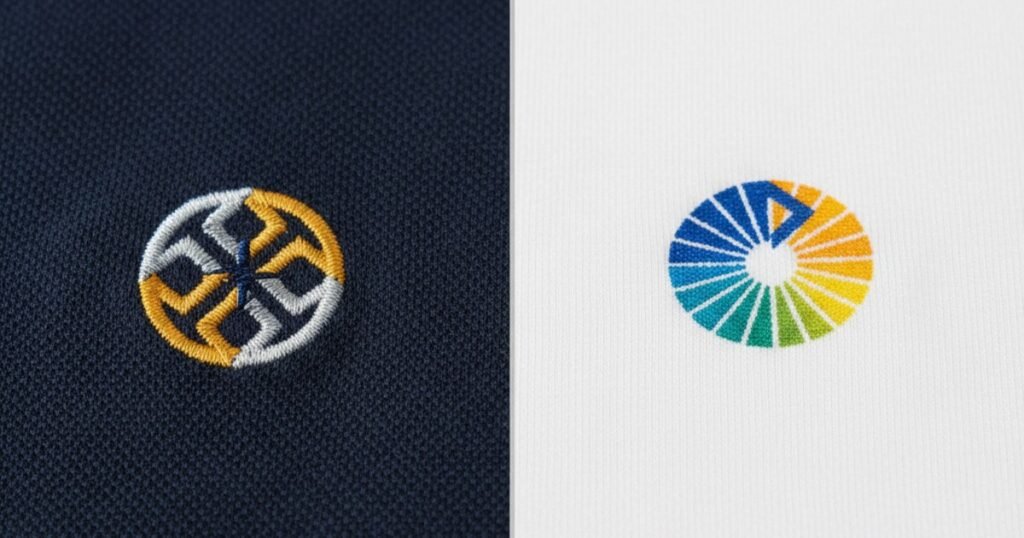
Embroidery stitches your logo straight into the fabric with thread. The design is sewn in, not sitting on top of the material, so it doesn’t fade, crack or peel. Not after hundreds of washes. Not after years of daily wear. That’s why it’s the default for a work uniform that has to look sharp for the long haul.
And it just looks the part. A neat embroidered logo on a polo shirt or fleece reads as established in a way a print rarely does. For customer-facing teams (trades, hospitality, healthcare, retail) that first impression counts.
Go with embroidery when:
- You’re branding everyday workwear that gets heavy use and frequent washing
- Your design is a logo or text, up to roughly a left-breast or cap size
- You want a premium finish that lasts the life of the garment
- You’re kitting out polos, jackets, fleeces, softshells or caps
Where it falls down: very large designs (a full back print, say), fine photographic detail, or artwork with lots of colour blends. Big embroidered areas push up the stitch count, which pushes up the cost, and they can feel heavy on thin fabric. That’s exactly where printing takes over.
Printing: bold, colourful, cheaper at volume
Printing puts your design on the surface of the garment. It handles big, bright, detailed artwork beautifully. Gradients, photographs, large back prints, multi-colour graphics that embroidery simply can’t reproduce. On lightweight fabrics like t-shirts, a print sits flat and comfortable where dense embroidery would feel stiff.
It also tends to work out cheaper once your design gets large or your order climbs. So it’s the go-to for event tees, promo runs, sports and leisure kit, and anything where a bold look matters more than a stitched finish.
Go with printing when:
- Your design is large, full-colour, or highly detailed
- You’re printing on t-shirts or lightweight garments
- You need a bigger quantity and want to keep the per-item cost down
- You’re producing event, promo or team wear where impact is the priority
Where it falls down: a print won’t ever feel quite as premium as embroidery. And on garments that get washed hard, day in day out, a stitched logo will usually outlast a printed one. For a flagship uniform you want looking its best in two years’ time, embroidery tends to win.
How to choose: a simple framework
Don’t pick one method for everything. Match the method to the job:
- By garment: polos, jackets, fleeces and hi-vis go to embroidery. T-shirts and lightweight tops go to printing. Hoodies work either way.
- By design: a logo or text is embroidery. A large, colourful or photographic design is printing.
- By durability: daily-wear uniform that’s washed constantly is embroidery. Occasional or event wear, printing is fine.
- By budget and quantity: small logos in modest numbers, embroidery is very affordable. Big designs or large runs, printing usually costs less per item.
A worked example
Say you run a growing landscaping firm and you’re kitting out eight people. The smart mix here is usually embroidered polos and softshells for everyday client-facing work (durable, smart, your logo on the chest), plus a run of printed t-shirts with a bigger logo or slogan for summer and busy jobs where comfort and visibility matter. One brand, two methods, each doing what it does best. That’s what we’d steer most small businesses toward, and it all goes on a single order.
The bottom line
There’s no universal winner here. Embroidery and printing solve different problems. Embroidery gives you a premium, near-indestructible finish that’s perfect for logos on everyday personalised workwear. Printing gives you bold, affordable, full-colour freedom that’s ideal for tees and larger designs. Get the match right and your team looks the part while your budget goes further.
Not sure which suits your kit? You can preview both on your own garments in minutes with our free online designer, or get in touch and we’ll recommend the best method for your logo, fabric and budget. We’ve been embroidering and printing for UK businesses for over 20 years.
Embroidery vs printing: FAQs
Is embroidery or printing better for workwear?
Neither is universally better. It depends on the garment and design. Embroidery is the durable, premium choice for logos on polos, jackets, fleeces and hi-vis. Printing is better for large, colourful or detailed designs and for lightweight t-shirts. Plenty of businesses use both.
Does embroidery or printing last longer?
Embroidery generally lasts longer. The thread is stitched into the fabric, so it won't fade, crack or peel, and it survives years of daily wear and frequent washing. A good print is hard-wearing too, but on heavily-washed uniforms embroidery usually outlasts it.
Is embroidery more expensive than printing?
For small logos in modest quantities, embroidery is very affordable. Printing usually becomes more cost-effective once your design is large or your order quantity is high, because embroidery is priced on stitch count while printing is priced on colours and volume.
Can I have embroidery and printing on the same order?
Yes. A common approach is embroidered polos and jackets for everyday client-facing wear, plus printed t-shirts for events or bigger designs, all branded consistently in one order.
Which is better for t-shirts?
Printing is usually the better choice for t-shirts. It sits flat and comfortable on lightweight fabric and handles big, bright designs well, whereas dense embroidery can feel stiff on a thin tee.
Which is best for hi-vis workwear?
Embroidery is a durable, professional option for logos on hi-vis. For very large designs or high-visibility back markings, printing can be the better fit. We can advise on the safest, longest-lasting option for your garments.

Written by Andy · Founder, Xcel Print & Promotions
Xcel Print & Promotions is a family-run UK workwear, branded-clothing and print company with over 20 years' experience. We embroider and print in-house from our base in Haverhill, Suffolk, with no minimum order, so this advice comes from kitting out real teams every working day, from single tradespeople to large sites and schools.
Leave a Reply