How to Add Your Logo to Work Uniforms: A Practical UK Guide
Last reviewed: 11 September 2026 · Written and reviewed by the Xcel Print & Promotions team
Published: 11 September 2026
To add your logo to work uniforms, you need to choose between embroidery (best for polos, fleeces and heavyweight items) or printing (best for t-shirts and large back designs), supply your artwork as a high-resolution vector or PNG file, pick suitable garments, and place your order with a specialist branded-workwear supplier. Lead times vary with demand and are confirmed when you order, and there is no minimum order required.
It sounds straightforward, and it really can be, but a surprising number of small businesses and sole traders trip up at the same two points: sending the wrong file format and choosing the wrong decoration method for the garment. Get those two things right and the rest of the process is genuinely easy. This guide walks you through every step, based on what we see day in, day out in our Haverhill workshop.
Why Does Branding Your Work Uniform Actually Matter?
Branded workwear does a job that marketing spend often can’t: it puts your name in front of customers at exactly the moment you’re doing the work. A plumber arriving in a plain polo and one arriving in a neat embroidered uniform are doing the same job, but the second one looks like an established business. On building sites, in care homes, in restaurants and in schools, we consistently hear the same thing from customers who’ve made the switch: the uniform pays for itself quickly because it builds instant trust.
There’s also a practical benefit. When your team all wear the same branded work uniform, it’s easier for customers to identify staff, and it quietly discourages people from wearing company kit off-duty, which matters if your brand is your reputation.
Embroidery or Printing, Which Is Right for Your Logo?
This is the most common question we get, and the honest answer is: it depends on the garment and the design.
When to choose embroidery
- polo shirts, fleeces, softshells, sweatshirts and jackets, embroidery sits beautifully on these and survives the kind of industrial washing that ruins printed designs.
- Logos with bold, clean shapes, fine hairlines and gradient effects don’t translate well to thread, but a solid logo with your company name embroiders crisply.
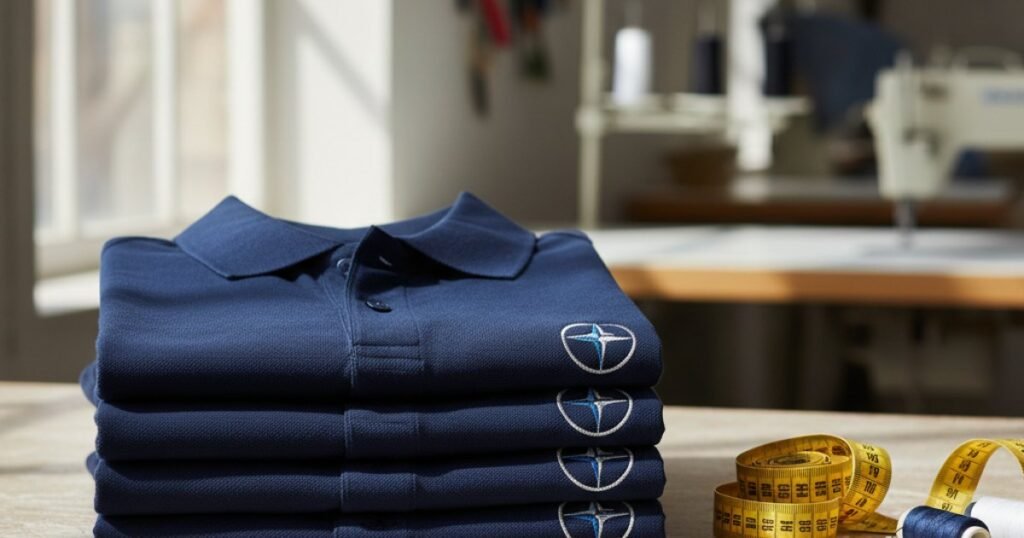
- Chest branding, a left-chest embroidered logo is the standard for professional trades and corporate uniforms alike. It’s durable, tactile and looks premium.
- hi-vis and safety garments, our custom hi-vis range is almost always decorated with embroidery because it won’t interfere with the garment’s reflective properties the way a large print placement might.
When to choose printing
- T-shirts and lighter fabrics, printing tends to work better on softer cotton t-shirts where the hand-feel of embroidery thread would feel stiff or heavy.
- Large back designs, a full-back logo, slogan or graphic is almost always printed. Embroidering that area is cost-prohibitive and rarely necessary.
- Photographic or complex artwork, if your brand uses gradients, photography or many colours, printing gives you much more flexibility.
- Casual team and promotional wear, for event tees and casual branded clothing, explore our custom t-shirts and hoodies/">personalised hoodies, which are well suited to printed logos.
If you’re genuinely unsure, tell us what garment you’re ordering and email your logo, we’ll advise on which route gives the best result. You can reach us via the contact page.
What Artwork File Do You Need to Send?
This is where orders get delayed, and it’s almost always avoidable. Here’s what you actually need:
- For embroidery: A high-resolution PNG (300 dpi minimum) with a transparent background, or, even better, a vector file (AI, EPS or SVG). We digitise your logo in-house free of charge, meaning we convert your artwork into a stitch file here in Haverhill rather than outsourcing it. That matters because we can call you directly if something won’t translate cleanly to thread, rather than guessing.
- For printing: A vector file is ideal. If you only have a JPEG or a low-resolution PNG, be upfront about it, we can often work with it, but a logo pulled from a website at 72 dpi will look soft on a garment and we’d rather tell you that upfront than produce something you’re not happy with.
- What to avoid: Screenshots, logos copied from Word documents, or anything that’s been resized up from a tiny original. These are the files that cause the most problems.
If your logo only exists as a low-quality file, you can also open our online designer from any product page to see your logo on a garment before ordering.
Choosing the Right Garments for Branded Workwear
Not every polo shirt or fleece is equal once you start washing it on a building site or putting it through a commercial laundry. We stock garments from brands like Portwest, Beeswift, Uneek and Regatta, not because they’re the cheapest, but because they hold their shape and colour through sustained use. A cheap blank garment might save a few pounds upfront but if the collar distorts or the fabric pills after ten washes, your logo looks scruffy by association.
For trades and site workers, we’d typically steer people towards a midweight polo or sweatshirt with a good percentage of polyester in the blend, it holds colour better and dries faster. For hospitality or retail, a softer cotton feel often matters more. For outdoor teams, a workers’ clothing layer like a Regatta softshell gives you something that looks professional and actually keeps people warm.
A Worked Example: Kitting Out a Small Electrical Firm
Here’s a realistic scenario we work through regularly. A two-person electrical firm wants to look the part when visiting customers’ homes. They need something professional but practical, not too formal, not too rough-and-ready.
We’d typically suggest: a left-chest embroidered logo on a midweight polo shirt for summer, and the same logo embroidered on a zip-through fleece for winter. Add a printed t-shirt for warmer weather on site. Total garments: maybe eight to twelve pieces across the two of them. No minimum order means they’re not forced to buy thirty of anything they don’t need.
The process looks like this: they email their logo (ideally as a PNG or vector), we confirm the stitch count and any simplifications needed, they approve a digital proof, we produce everything in-house and despatch. Lead times vary with demand and are confirmed when you order, with reorders often faster because the logo is already digitised.
The result is a team that looks consistent, identifiable and professional, without spending a fortune or ordering stock they’ll never use.
What’s the Ordering Process at Xcel Print & Promotions?
We’ve kept it deliberately simple, because small businesses don’t have time for complicated procurement processes.
- Browse garments and choose your style, colour and sizes.
- Submit your logo artwork, via email or our contact page.
- We’ll confirm decoration method, logo placement and any artwork adjustments needed.
- Approve your digital proof.
- We produce everything in-house at our Haverhill facility and despatch to you.
There’s no minimum order, so whether you need two garments or two hundred, the process is the same. Our personalised workwear and embroidered workwear pages give you a full picture of what’s available.
Who Is This Not Right For?
It’s worth being honest here. If you need extremely complex, photorealistic artwork embroidered at very small sizes, say, a detailed crest at 2cm wide, embroidery will always involve some simplification. It’s a physical process with real thread, not a printer. Some logos with very fine detail or many gradient colours need to be adapted slightly for embroidery. We’ll always tell you this before you commit, and we’ll show you how the adapted version looks before we stitch a single garment.
Equally, if you need same-day turnaround, that’s rarely possible for custom branded workwear, the digitising, proofing and production steps take time and rushing them produces poor results. Build in sensible lead time, we confirm exact timings when you order.
Ready to Add Your Logo to Your Uniform?
The quickest way to get started is to get in touch with us and send your logo. We’ll come back to you with a recommendation on decoration method, a quote and a timeline, usually within one working day. No jargon, no pressure, no minimum order.
FAQs
How do I add my logo to work uniforms in the UK?
You choose between embroidery or printing depending on the garment and design, supply your logo as a high-resolution file (vector or PNG preferred), select your garments, and place your order with a branded workwear supplier. Lead times vary by supplier and demand, and a good supplier confirms the timing when you order.
Is embroidery or printing better for work uniforms?
Embroidery is generally better for polos, fleeces, sweatshirts and hi-vis garments because it's highly durable and survives repeated washing. Printing is better for t-shirts, large back designs and complex multi-colour artwork. For most trades and professional uniforms, embroidery on the left chest is the standard approach.
What file format do I need to send for my logo?
A vector file (AI, EPS or SVG) is ideal for both embroidery and printing. A high-resolution PNG (300 dpi minimum) with a transparent background also works well. Avoid low-resolution JPEGs, screenshots or logos copied from Word documents, these typically produce poor results on garments.
Is there a minimum order for branded workwear?
At Xcel Print & Promotions, there is no minimum order. You can order a single embroidered polo or a single printed t-shirt if that's what you need. This makes branded workwear accessible for sole traders and very small teams.
How long does it take to get my logo added to workwear?
Lead times vary with demand and are confirmed when you order. Reorders, where your logo is already digitised, are often faster. Same-day turnaround is not realistic for custom embroidered or printed garments.
Will the logo survive washing and heavy site use?
Embroidery is extremely durable and handles industrial washing and site conditions well, which is why it's the standard for trades workwear. Printed designs also hold up well on appropriate garments when applied correctly. Choosing quality garments from reputable brands makes a significant difference to how long both the garment and the decoration last.

Written by Andy · Founder, Xcel Print & Promotions
Xcel Print & Promotions is a family-run UK workwear, branded-clothing and print company with over 20 years' experience. We embroider and print in-house from our base in Haverhill, Suffolk, with no minimum order, so this advice comes from kitting out real teams every working day, from single tradespeople to large sites and schools.
Leave a Reply