What to Look for in a Workwear Supplier (Honest Guide)
Last reviewed: 8 September 2026 · Written and reviewed by the Xcel Print & Promotions team
Published: 8 September 2026
When choosing a workwear supplier, the things that matter most are garment quality and durability, in-house decoration capability (embroidery and/or printing), honest minimum order policies, realistic UK turnaround times, and clear communication before and after the sale. Getting these five things right means your team looks professional, your branding lasts, and you’re not chasing a supplier every time you need a reorder.
It sounds straightforward, but the workwear market is crowded, and not all suppliers are set up in the same way. Some dropship from overseas, some outsource their decoration, some have minimum orders that simply don’t work for a small team. Having kitted out trades teams, hospitality staff, construction crews and school groups from our workshop in Haverhill, we’ve seen what goes wrong when the supplier relationship isn’t quite right. This guide is designed to help you ask the right questions before you commit.
Why does the supplier’s decoration setup matter so much?
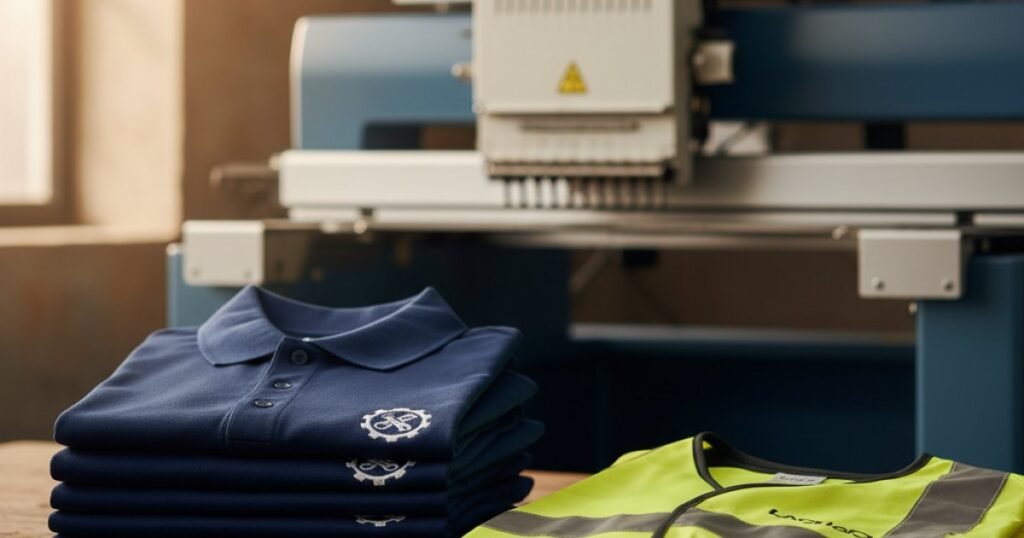
Decoration, whether that’s embroidery or printing, is where a lot of corners get cut. Many online workwear companies take your order, then send the blank garments to a third-party decorator. That introduces extra handling, longer lead times, inconsistent results, and a muddier chain of responsibility if something goes wrong.
When embroidery and printing are done in-house, the same team that talks to you also stitches or prints your logo. Quality control is tighter. Turnarounds are faster. And if there’s an issue, a thread colour that’s slightly off, a print that needs repositioning, it’s caught and fixed before it leaves the building, not when it arrives at your door.
It’s worth asking any potential supplier directly: do you decorate in-house, or do you outsource? The honest answer tells you a lot.
What garment brands should a good workwear supplier stock?
The brand of the blank garment matters more than most buyers realise. A cheap unbranded polo might look fine on day one, but after a dozen washes on a building site or in a commercial kitchen, it can shrink, fade and lose its shape quickly. That reflects poorly on your business, not just the garment.
Look for suppliers who carry established, tested workwear brands, the kind that comply with relevant European and UK safety standards and have a track record in professional environments. Brands like Portwest, Beeswift, Uneek and Regatta are widely used across UK industries for good reason: they’re designed for real working conditions, they wash well, and they’re sized consistently, which matters when you’re ordering for a team.
If a supplier can’t tell you who makes the blanks, or the product listings lack any fabric or compliance information, that’s a red flag.
Does minimum order quantity actually matter for small businesses?
Yes, enormously. A supplier with a minimum order of 24 or 48 pieces is simply not practical for a sole trader wanting two branded polo shirts, a start-up kitting out six staff, or a manager who needs to replace one embroidered jacket. Yet plenty of workwear companies still operate this way.
No-minimum suppliers give small businesses the same access to professional branded clothing as large corporates. You can order what you actually need, rather than being forced to over-buy and tie up cash in stock. It also means you can test a garment style or colour before committing to a larger run, a sensible approach if you’ve not ordered workwear before.
If you do have a larger team to kit out, a good supplier should be able to scale with you, handling mixed sizes, multiple garment types and phased orders without making it complicated.
What turnaround times are realistic for branded workwear in the UK?
Turnaround expectations vary depending on the complexity of your artwork and the decoration method, but as a general rule, a UK-based supplier with in-house decoration should be able to turn around most orders within five to ten working days once artwork is approved. Some straightforward jobs can be faster (for reference, we work to five to seven working days from artwork approval).
Be cautious of suppliers who can’t give you a clear timeline, or who quote lead times of several weeks for standard work. That often means the order is going overseas or through multiple hands. It also means that if something goes wrong, you have very little time to correct it before your deadline.
If you have a genuine time-sensitive need, a new starter on Monday, a trade show next week, ask the question upfront. A good supplier will be honest about what’s achievable, not just tell you what you want to hear.
How do you judge the quality of embroidery and print before ordering?
Ask to see samples. A supplier confident in their work will have no hesitation showing you examples, whether that’s an embroidered logo on a fleece, a printed design on a custom T-shirt, or a chest badge on a hoodies/">personalised hoodie. If samples aren’t available, ask to see photos of real finished orders, not just product mock-ups.
For embroidery specifically, look at the back of the garment as well as the front. Neat, well-tensioned stitching on the reverse is usually a good sign of a properly set-up machine and experienced operator. Loose loops, puckering or inconsistent density on the face of the logo suggests rushed or under-maintained work.
For printed workwear, ask about wash durability. A print that peels or cracks after a handful of washes is a false economy, particularly on personalised workwear intended for daily professional use.
A worked example: a small trades business getting it right
Imagine a self-employed plumber setting up a small team of four. He needs branded polo shirts, a fleece each and a couple of hi-vis/">custom hi-vis vests for site work. His logo is already on his van, a decent vector file his sign writer used.
He contacts a supplier, sends the logo file, and asks three questions: can you do small quantities, what’s the turnaround, and is the decoration done by you or sent away? The right supplier says yes to small quantities, quotes a realistic lead time, confirms in-house embroidery and asks him which garments he’d like to see the logo digitised onto first. He approves a digital proof, the order ships within the week, and the branding matches across every item.
That’s the experience a good supplier should consistently deliver, no drama, no surprises, professional results. If you’re not sure where to start, you can open our online designer from any product page to visualise how a logo sits on different garments before you commit.
What questions should you ask a workwear supplier before placing an order?
- Do you decorate in-house, or do you use a third party?
- What brands of garments do you stock, and are they safety-rated where relevant?
- Is there a minimum order quantity?
- What’s your realistic turnaround from artwork approval to dispatch?
- Can I see samples or photos of finished work?
- What file format do you need for my logo, and do you charge for digitising?
- What’s your process if something isn’t right when the order arrives?
Key factors at a glance
| Factor | What to look for | Red flag |
|---|---|---|
| Decoration | In-house embroidery and/or printing | Outsourced to unknown third party |
| Garment brands | Named, established brands with fabric/compliance details | Unbranded blanks with no specification |
| Minimum order | No minimum, or a low threshold suitable for small teams | MOQ of 24+ for a basic polo |
| Turnaround | Clear timeline quoted upfront, typically within 5-10 working days | Vague lead times or multi-week waits for standard work |
| Communication | Proof approval process, responsive to queries | No artwork sign-off or poor pre-sale response |
| After-sale support | Clear process if something goes wrong | No returns or complaints policy visible |
Who is this guide not for?
If you’re running a large corporate procurement programme with thousands of units per quarter and a dedicated buying team, your needs, and the supplier conversations you need to have, will be more complex than this guide covers. Large-volume buyers often negotiate pricing tiers, dedicated account management and bespoke stock-holding arrangements. Those are valid requirements, but they’re a different conversation.
This guide is written for the people who make up the majority of the workwear market: small businesses, growing trades teams, sports clubs, schools and team managers who need professional results without the corporate overhead.
Ready to find the right supplier?
If you’re weighing up your options and want a straight answer about what we can do for your team, including full work uniform packages or individual pieces, the best thing to do is get in touch. We’re a family business that’s been doing this for over two decades, and we’re happy to talk through what you need before you commit to anything. Visit our contact page and we’ll come back to you promptly.
FAQs
What is the most important thing to look for in a workwear supplier?
In-house decoration capability, meaning the supplier does their own embroidery and/or printing rather than outsourcing it, is arguably the single most important factor. It means better quality control, faster turnarounds and clearer accountability if anything needs correcting.
Do workwear suppliers in the UK have minimum order requirements?
Many do, particularly larger wholesale operations, which often require 12, 24 or even 48 pieces per design. However, a number of UK suppliers, including smaller, family-run businesses, operate with no minimum order, making them far more suitable for small teams or one-off requirements.
How long does branded workwear typically take to produce in the UK?
For a supplier with in-house decoration, most standard orders can be completed within five to ten working days from artwork approval. More complex jobs or larger quantities may take longer. Always confirm the lead time upfront, especially if you have a deadline.
What file format does a workwear supplier need for my logo?
Most suppliers prefer a vector file (such as an AI, EPS or PDF file with embedded fonts/outlines) as it can be scaled without loss of quality. A high-resolution PNG or JPEG may be acceptable for some print work but is rarely sufficient for embroidery digitising. If you only have a low-resolution logo, ask the supplier what they can do, many can work with what you have or suggest a redraw.
Is embroidered workwear more durable than printed workwear?
Embroidery is generally more durable in heavy-wash environments, it won't peel or fade the way a print can over time, which is why it's the preferred choice for workwear that gets washed frequently. That said, high-quality printing on the right fabric can also be very long-lasting, and print suits certain designs (large graphics, photographic images, fine detail) that don't translate well into stitching. A good supplier will advise which decoration method suits your specific garment and design.
Can a workwear supplier kit out a mixed team with different roles and clothing needs?
Yes, a good supplier should be able to handle mixed orders covering different garment types, sizes and roles within the same team. For example, a construction firm might need hi-vis jackets for site workers, polo shirts for supervisors and printed T-shirts for a different department, all with consistent branding. Look for a supplier who can manage this without requiring you to place separate orders or meet separate minimums for each item.

Written by Andy · Founder, Xcel Print & Promotions
Xcel Print & Promotions is a family-run UK workwear, branded-clothing and print company with over 20 years' experience. We embroider and print in-house from our base in Haverhill, Suffolk, with no minimum order, so this advice comes from kitting out real teams every working day, from single tradespeople to large sites and schools.
Leave a Reply