Workwear for Hospitality Staff: A Practical Buying Guide
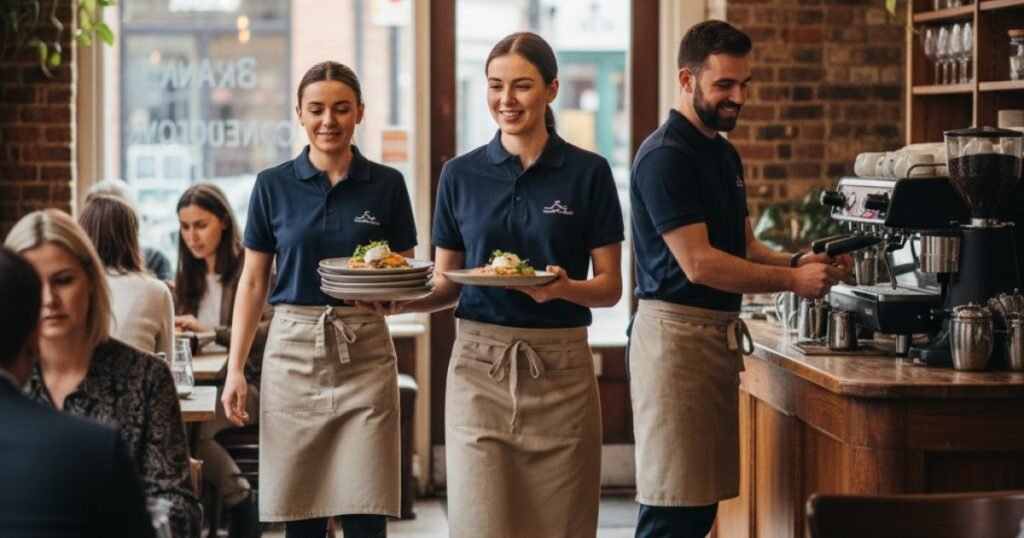
Last reviewed: 28 September 2026 · Written and reviewed by the Xcel Print & Promotions team
Last updated: 28 September 2026
Workwear for hospitality staff needs to do three things at once: look smart enough to represent your brand, feel comfortable enough to wear for a full shift, and survive the kind of repeated commercial washing that destroys cheap garments within a few months. The right combination of fabric, fit and decoration method makes all the difference, and getting it wrong is an expensive lesson.
Why hospitality workwear is harder to get right than most people expect
Walk into almost any busy restaurant, hotel or café and you will notice the staff within seconds, whether that is because their uniform looks sharp and consistent, or because it looks tired, mismatched and vaguely reluctant. Hospitality is one of those sectors where workwear genuinely affects how customers feel about a business before a single word is spoken.
But there is a practical challenge that sits behind the aesthetics. Hospitality teams are hard on clothes. A chef whites situation is obvious, but even front-of-house staff, servers, baristas, reception teams, are on their feet for eight to twelve hours, spilling things, wiping things down, rushing between hot kitchens and air-conditioned dining rooms. Add commercial laundering on high temperatures and most budget garments start pilling, fading or shrinking within a season.
At our workshop in Haverhill, we kit out a fair number of hospitality businesses, from small independent cafés ordering five or six polo shirts to larger hotel groups needing a consistent look across multiple roles. The questions we hear most often are the same: what fabric holds up, how do we get our logo on it properly, and what happens when we need to replace one or two items quickly without ordering a bulk minimum? This guide answers all three.
What fabrics actually work for hospitality uniforms?
Fabric choice is where most first-time buyers go wrong. Here is an honest breakdown of the main options:
- 100% cotton: Breathable and comfortable, which front-of-house staff appreciate. The trade-off is that pure cotton shrinks and fades faster under commercial washing. If you choose cotton, budget for more frequent replacement.
- Poly-cotton blends (typically 65/35 or 50/50): The workhorse of hospitality workwear. The polyester content resists shrinkage and holds colour better through repeated washes, while the cotton keeps it breathable. Most of the polo shirts and tunics we embroider for hospitality clients are in this category.
- 100% polyester (performance fabrics): Excellent moisture management, ideal for kitchen staff or anyone who runs warm. Modern performance polyester does not have the sheen or scratchy feel of older versions. Worth considering for kitchen teams and bar staff.
- Softshell and fleece: Relevant for outdoor hospitality, events, festival bars, beer gardens, or for staff who move between indoor and outdoor spaces. A branded softshell doubles as a practical layer and a walking advertisement.
Our general recommendation for most front-of-house roles is a poly-cotton polo or tunic from a trusted brand like Uneek or Portwest. They are proven to hold their shape and colour, they embroider cleanly, and they sit at a price point that makes replacing individual items practical rather than painful.
Embroidery or printing, which is right for hospitality uniforms?
This is genuinely one of the most common questions we get, and the honest answer depends on what you are decorating and how it will be used.
Embroidery is the default choice for most hospitality workwear, polo shirts, fleeces, softshells, chef jackets and similar items. It looks professional and premium, it does not crack or peel, and it holds up brilliantly through commercial washing. A well-digitised embroidered logo on a poly-cotton polo will still look presentable after hundreds of washes. This is what we do in-house, and the quality difference between properly set-up embroidery and a rushed job is visible immediately.
The one limitation of embroidery is detail. Very fine lines, very small text, or complex photographic artwork do not translate well into thread. If your logo has thin serifs or gradients, we will tell you honestly when we set it up, sometimes a slight simplification at small sizes actually makes a logo read better on a garment anyway.
Printing is the better choice for bold, large-format designs, full-back graphics, or garments like custom T-shirts used for events, promotional purposes or seasonal campaigns. If you run a summer pop-up or a festival bar and want a striking T-shirt design for a large team, printing gives you more creative range. Our printing is handled in-house alongside our embroidery, so you are not juggling two different suppliers.
A worked example: kitting out a small restaurant team
Imagine you are opening a 30-cover independent restaurant. You have six front-of-house staff, two kitchen staff and yourself front-of-house occasionally. Here is how we would typically approach this:
- Front-of-house: Embroidered poly-cotton polo shirts in your brand colour (or black, always safe), with your logo on the left chest. Two per staff member gives one to wear and one in the wash. That is twelve polos.
- Kitchen: Performance polyester tunics or chef whites, embroidered with a small logo if you want consistency, or plain if the kitchen is never customer-facing.
- Yourself and senior staff: Consider a smarter embroidered softshell or sweatshirt for cooler months, it reads as authority without being stuffy.
Because we have no minimum order, you can order exactly what you need. There is no obligation to buy in dozens when you only need nine or twelve items. And when a new staff member joins in three months, you can add two or three items to a new order without drama.
For the full range of options, our work uniform and personalised workwear sections are a useful starting point.
How should hospitality businesses handle sizing and replacements?
Staff turnover in hospitality is a real operational issue, and workwear ordering needs to account for it. A few practical thoughts from experience:
- Order a small buffer of the most common sizes (typically M, L, XL) so you can hand a new starter something on their first day rather than making them wait two weeks.
- Keep a note of the exact garment style and colour code you ordered. Nothing is more frustrating than trying to reorder six months later and finding the new batch is a slightly different shade of navy because you cannot remember the original spec.
- If you have multiple roles with different uniform items, keep it simple, one garment style across all front-of-house staff reads as more professional than a mix-and-match of whatever was cheapest each time.
Who is this guide NOT for?
It is worth being honest about the limits here. If you are a large hotel group or contract caterer with hundreds of staff and need a fully managed uniform programme with complex sizing matrices and warehousing, we are a strong choice for the production side but you should also be talking to a specialist uniform management company about the logistics layer.
Similarly, if you need high-visibility workwear for outdoor hospitality construction or events setup, that is a different conversation, our hi-vis/">custom hi-vis range covers those requirements separately.
This guide is aimed squarely at independent restaurants, cafés, pubs, hotels, bars and catering businesses with teams of roughly five to fifty staff who want quality branded workwear without the complexity or cost of a corporate uniform contract.
How do I get a quote for hospitality workwear?
The quickest way is to come to us with three things: what garments you want, how many, and your logo file (an SVG, PDF or high-resolution PNG works best). If you do not have a logo file to hand, our online designer (it opens from any product page) can help you put something together, or get in touch and we will work through it with you.
Pricing varies by garment, quantity and complexity of decoration, but as a rough guide, embroidered polo shirts for small hospitality teams typically fall somewhere in the range of £15-£35 per item, that is a general steer, not a quote, and your actual price will depend on the specific garment and logo setup. We will always give you a clear price before anything is confirmed.
For teams who want to explore hoodies/">personalised hoodies or workers clothing for back-of-house roles, those sections give a broader picture of what is available across the range.
Get it right once and your uniform becomes a genuine asset, consistent, professional, and one less thing to worry about when you are running a busy service.
FAQs
What is the best fabric for hospitality staff uniforms?
For most front-of-house roles, a poly-cotton blend (65/35 or 50/50) is the best all-round choice, it breathes well enough for a long shift, resists shrinkage and holds colour through repeated commercial washing. For kitchen or high-activity roles, a performance polyester fabric is worth considering for its moisture management.
Is embroidery or printing better for restaurant and café uniforms?
Embroidery is generally the better choice for hospitality workwear like polo shirts, tunics and fleeces, it looks premium, does not crack or peel, and survives commercial laundering extremely well. Printing is better suited to bold large-format designs, event T-shirts or promotional garments where design complexity or size makes embroidery impractical.
Can I order small quantities of workwear for a small hospitality team?
Yes. At Xcel Print & Promotions we have no minimum order requirement, so you can order exactly what you need, whether that is five polo shirts or fifty. This is particularly useful for small independent businesses and for topping up stock when new staff join.
How long does branded hospitality workwear take to produce?
Turnaround depends on the order size and whether your logo needs setting up for the first time, but we aim for a fast UK turnaround from our in-house workshop. Contact us with your requirements and we will give you a realistic lead time upfront.
What file format do I need for my logo when ordering workwear?
An SVG, PDF or high-resolution PNG gives us the cleanest starting point for setting up embroidery or printing. If you do not have a suitable file, we can often work from what you have or help you through our online designer tool.
How do I manage workwear when staff turnover is high?
Order a small buffer stock of your most common sizes so new starters can be kitted out immediately. Keep a record of the exact garment style and colour code so reorders are consistent. Because there is no minimum order with us, adding a few items to a new order whenever you need to is straightforward and cost-effective.

Written by Andy · Founder, Xcel Print & Promotions
Xcel Print & Promotions is a family-run UK workwear, branded-clothing and print company with over 20 years' experience. We embroider and print in-house from our base in Haverhill, Suffolk, with no minimum order, so this advice comes from kitting out real teams every working day, from single tradespeople to large sites and schools.
Leave a Reply