How Much Does It Cost to Embroider a Logo? A Straight Answer
Last reviewed: 8 September 2026 · Written and reviewed by the Xcel Print & Promotions team
Last updated: 8 September 2026
Embroidering a logo onto workwear or branded clothing in the UK typically costs around £3 to £8 per garment for a standard chest logo, plus, at many suppliers, a one-off digitising fee of £15 to £40. At Xcel digitising is free. The exact price hangs on stitch count, garment position, and how many items you’re ordering. There’s no single magic number. But this guide walks you through every variable so you can budget properly before you commit.
Why there’s no single ‘price per logo’ for embroidery
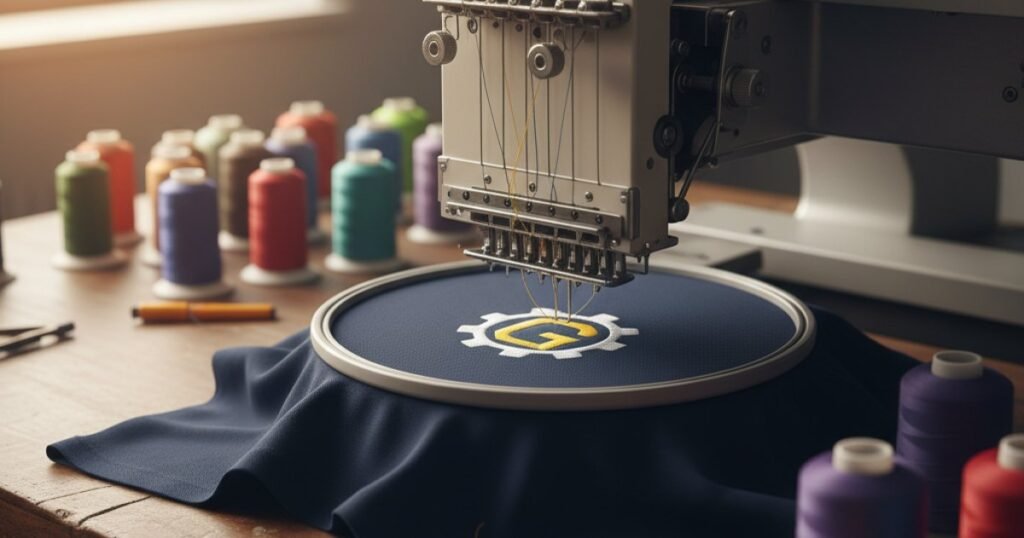
It’s one of the most common questions we get at our Haverhill workshop, and the honest answer is that embroidery isn’t priced like a flyer with a fixed page rate. Every logo is stitched individually, needle by needle, so the time (and thread) the machine uses is what determines the cost. A crisp two-colour company name on a left chest takes far fewer stitches than a full-colour crest with fine text and shading. The price reflects that difference.
Once you understand the main variables below, though, the pricing gets very predictable. Most clients are surprised by how affordable embroidery is over the long run. A logo stitched into a fleece jacket will outlast the garment itself, which is why it’s still the decoration method of choice for professional embroidered workwear across trades, hospitality, healthcare and beyond.
What actually drives the cost of embroidering a logo?
1. Stitch count
This is the single biggest factor. Embroidery is priced by how many stitches are needed to recreate your design. A simple text logo at around 5,000-8,000 stitches costs considerably less to run than a detailed company crest that might need 15,000-25,000 stitches or more. When you send us your artwork, our in-house team works out the stitch count as part of digitising, so you’ll know before you commit.
2. Digitising (the one-off setup fee)
Before your logo can be embroidered, it has to be converted from an image file into a stitch file. A process called digitising. This is skilled work: a good digitiser decides exactly how each element of your logo should be stitched, in which direction, and at what density so the result looks sharp on fabric. Done properly, it makes an enormous difference to the finished quality.
Most suppliers charge this fee once; at Xcel digitising is free, and your file is stored for every future order. If a supplier charges you a digitising fee on every single order, push back. That’s not standard practice.
3. Number of garments
Embroidery on a commercial multi-head machine means several garments can run at once. The more items you order, the lower the cost per piece tends to be, because the machine time and setup is spread across the run. At Xcel we have no minimum order, so a sole trader ordering five polo shirts still pays a fair price. But if you’re kitting out a team of thirty, the per-item cost will naturally be friendlier.
4. Position and number of logo placements
A single left-chest logo is the most economical option. Add a second placement, say a name on the right chest or a back print, and you’re essentially doubling the embroidery work on that garment. Each position is priced separately. Think carefully about what you actually need. For most tradespeople and small business teams, one well-placed logo does the job perfectly.
5. Garment type and fabric
The garment itself affects cost indirectly. Thicker, structured fabrics like fleeces and jackets hold embroidery beautifully and are easy to hoop. Some stretchier or very lightweight fabrics need extra care, backing materials and slower running speeds, which can add a small amount to the price. Worth asking about when you’re choosing your garments.
A worked example: kitting out a small plumbing team
Say you run a four-person plumbing business and you want your logo embroidered onto polo shirts for the whole team, with a name on each shirt too.
- Garments: 4 polo shirts (a quality mid-range polo from a brand like Uneek or Portwest, typically £8-£18 per shirt depending on style and colour)
- Digitising: One-off fee for your company logo (paid once, kept on file forever)
- Logo embroidery, left chest: Per-garment embroidery cost × 4
- Name embroidery, right chest: A small additional cost per shirt (names are usually low stitch count)
Total per shirt, garment plus all embroidery, might land somewhere around £20-£35 depending on the shirt choice and your logo complexity. For workwear worn daily, representing your business on every job, that’s not a lot of money. And every repeat order after that drops in cost because the digitising is already done.
Want a proper quote for exactly this kind of setup? The quickest route is our contact page. Just send us your logo file and tell us the garments and quantities you’re thinking about.
How does embroidery compare to printing for logos on clothing?
| Factor | Embroidery | Printing |
|---|---|---|
| Setup cost | Free at Xcel (many charge a one-off digitising fee) | Varies by method; often lower for simple designs |
| Durability | Extremely high, survives industrial washing | Good; varies by method and garment care |
| Best for | Polos, fleeces, jackets, caps, workwear | T-shirts, hi-vis, large back prints, photographic designs |
| Fine detail / gradients | Limited, very fine text or photographic images don’t always stitch well | Better suited to complex photographic artwork |
| Perceived quality | Premium, textured, professional | Clean and flat, great for bold graphic designs |
| Minimum order | None at Xcel | None at Xcel |
For personalised workwear that needs to look sharp and last for years, embroidery is nearly always the right call. For something like a promotional custom t-shirt with a large chest graphic, printing often makes more sense. We offer both in-house, so you’re never forced into the wrong option.
What makes a logo work well in embroidery?
This is where customers sometimes come unstuck. A logo that looks great on a website or business card doesn’t automatically translate to stitches. The things that tend to cause problems:
- Very thin lines or tiny text, anything under about 4-5mm in height struggles to stitch cleanly and can blur on fabric.
- Photographic or heavily gradient artwork, embroidery works in solid thread colours; gradients and photos need simplifying or re-interpreting.
- Extremely complex colour counts, each thread colour requires a change, which adds time and cost.
Our in-house team will always tell you honestly if your logo needs simplifying before we digitise it. We’d far rather have that conversation upfront than produce something you’re not happy with. If you need help preparing artwork, we also offer a design service to get your logo embroidery-ready.
Who is embroidery NOT the right choice for?
Worth being straight about this. Embroidery isn’t ideal if:
- You need a very large back print (say, A3-sized). Embroidery at that scale gets expensive and heavy on the fabric; printing is the better route.
- Your logo is photographic or relies on smooth colour blending. It simply won’t reproduce faithfully in thread.
- You’re producing short-run promotional items where cost per piece matters more than longevity. Printing may be more economical for a one-off event giveaway.
- You need logos on hi-vis vests with safety-critical placement. Always check that embroidery doesn’t compromise the certified visibility areas of the garment.
For most small business owners, trades teams, and anyone producing work uniforms or hoodies/">personalised hoodies meant to last, embroidery is almost always the right investment.
How to get an accurate embroidery quote
The fastest way to get a real number, not a ballpark, is to send us your logo file (vector or high-resolution image), the garments you’re interested in, the placements you want, and your quantity. We’ll come back to you with a proper quote based on the actual stitch count, not guesswork. No obligation, no hard sell.
Head to our contact page or browse our embroidered workwear range to find the right garments first, then get in touch and we’ll take it from there.
FAQs
How much does it cost to embroider a logo onto a polo shirt in the UK?
For a standard left-chest logo, embroidery on a polo shirt typically costs roughly £3 to £8 per garment on top of the garment price itself, depending on the stitch count and quantity ordered. Many suppliers also charge a one-off digitising fee of £15 to £40; at Xcel digitising is free and your stitch file is stored for all future orders.
What is a digitising fee and do I have to pay it every time?
Digitising is the process of converting your logo artwork into a stitch file that embroidery machines can read. It’s skilled work, and at Xcel it’s free. Once your logo is digitised it’s saved on file for all repeat orders.
Is there a minimum order for embroidered workwear?
At Xcel Print & Promotions there’s no minimum order. You can order a single embroidered garment if you need to, though ordering more items does drop the cost per piece as the setup cost is spread across the run.
How long does embroidered workwear last compared to printed clothing?
Embroidery is extremely durable and will typically outlast the garment itself. It holds up well through repeated industrial and commercial washing cycles. Printing is also durable when applied correctly, but embroidery is generally considered the more hard-wearing option for daily workwear.
Can any logo be embroidered, or do some designs not work?
Most logos embroider well, but very fine lines, tiny text (under about 4-5mm tall), photographic images and complex colour gradients can be difficult to reproduce faithfully in thread. A good embroidery company will advise you on any changes needed before digitising your artwork.
Is embroidery or printing better for workwear?
Embroidery is generally better for professional workwear, especially polos, fleeces, jackets and caps, because it looks premium, feels substantial, and survives tough washing conditions. Printing tends to suit large back graphics, photographic designs, hi-vis garments and lower-cost promotional items better. Many businesses use both methods depending on the garment type.

Written by Andy · Founder, Xcel Print & Promotions
Xcel Print & Promotions is a family-run UK workwear, branded-clothing and print company with over 20 years' experience. We embroider and print in-house from our base in Haverhill, Suffolk, with no minimum order, so this advice comes from kitting out real teams every working day, from single tradespeople to large sites and schools.
Leave a Reply