How to Get a Logo Embroidered on Workwear: A Plain Guide
Last reviewed: 17 August 2026 · Written and reviewed by the Xcel Print & Promotions team
Last updated: 17 August 2026
To get a logo embroidered on workwear you need three things: a suitable logo file (ideally a vector or high-resolution image), a clear idea of placement and size, and a decorated-clothing supplier who digitises your design into a stitch file and applies it in-house. The process is straightforward once you know what to prepare. And the result, stitched directly into the fabric, is durable, professional and far more wash-resistant than any print on a heavy-duty garment.
This question comes up constantly at our Haverhill workshop. A plumber starts hiring apprentices. A care company wants its staff to look the part. A groundworks firm clocks that its team are turning up in a jumble of different hoodies, and suddenly branded workwear jumps up the to-do list. Embroidery is usually the right answer for that kind of everyday, hard-working uniform. But there are a few things worth understanding before you hit ‘order’. Get them right and you’ll be delighted. Get them wrong and you’ll be back asking for a redo.
What exactly is workwear embroidery and why does it last?
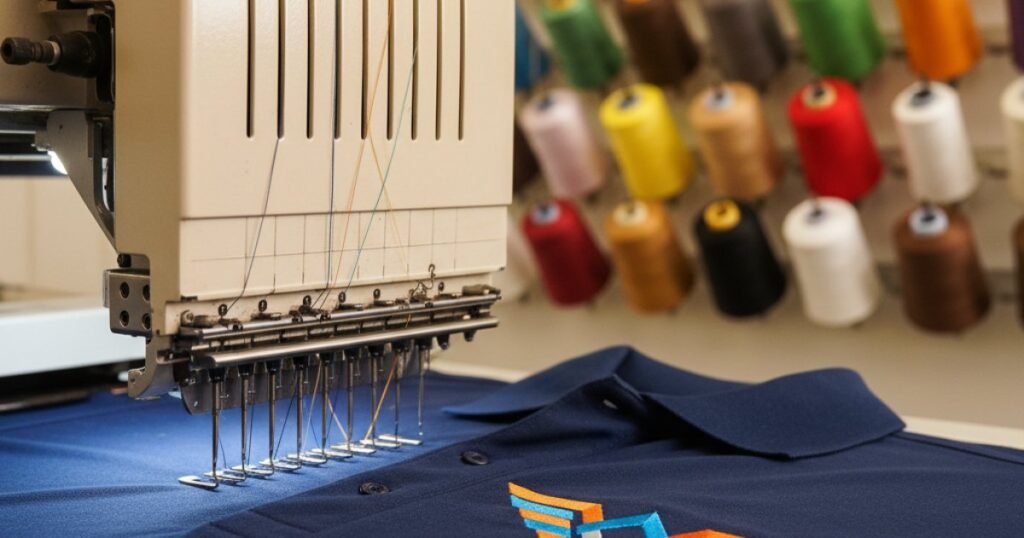
Embroidery is the process of stitching a design straight into the fabric of a garment using industrial machines. No transfer, no film, nothing sitting on the surface that can crack or peel. The stitches become part of the garment. That’s why embroidery is the standard choice for embroidered workwear that gets washed regularly, worn hard and still expected to look smart after a year in service, not just a year in a drawer.
For trades, construction, healthcare and hospitality, this matters. A lot. A logo on a fleece jacket that goes through an industrial wash twice a week needs to still look sharp six months in. Embroidery, done properly, does that. Printing has its place, especially on lighter fabrics and promotional pieces, but for the core uniform garments, embroidery wins on longevity.
What logo file do you need for embroidery?
This is where people trip up most often. Embroidery doesn’t use your logo file directly. A machine can’t ‘read’ a JPEG and start stitching. Your artwork has to be converted into a stitch file, a process called digitising, where a skilled operator maps out every thread path, angle and density. The quality of that digitising job has a huge effect on the finished result.
What you should send your supplier:
- A vector file (.ai,.eps or.svg). These are infinitely scalable and give the digitiser the cleanest lines to work from. This is the ideal.
- A high-resolution PNG or PDF, at least 300 dpi at the intended print size. Workable, but ask your supplier first.
- A low-resolution JPEG pulled from a website. Generally not usable without redrawing. If it’s all you’ve got, a good supplier will flag it early.
If your logo doesn’t exist as a vector, you’ve got two options. Ask whoever designed it originally (they almost certainly have the master file), or use a design service to have it redrawn properly. Don’t skip this step. A poorly prepared file produces uneven stitches, blurry edges and a result that looks nothing like your brand.
One honest note. Very fine detail, thin serifs and tiny text below roughly 5-6mm tall don’t translate well to embroidery. If your logo has these features, a good digitiser will simplify them slightly. That’s normal and sensible, not something to argue about.
Which workwear garments can be embroidered?
Almost anything with a stable woven or knitted surface: polo shirts, sweatshirts, fleeces, softshells, work jackets, caps, beanies and hi-vis vests. The main exception is very thin, stretchy or loosely woven fabrics. Embroidery pulls at lightweight fabric, which can distort the garment. For those, printing is usually the better route.
At Xcel we work with trusted brands including Portwest, Beeswift, Uneek and Regatta. Garments built to be decorated and hold their shape under the hoop. Choosing a reputable brand matters: cheap unbranded blanks often have inconsistent fabric weights and uneven seams that make clean embroidery harder to pull off.
If your team works in construction or roadside environments, custom hi-vis with an embroidered logo is a popular, practical choice. It keeps your team compliant and identifiable at the same time. For a broader uniform setup covering multiple garment types, have a look at our work uniform options to see what can be pulled together as a set.
Where should your logo go on the garment?
Placement affects both how professional the result looks and how practical it is in daily wear. Common positions and what they suit:
- Left chest, the classic. Works on virtually every garment type, keeps the logo visible without being in your face. The standard choice for most business uniforms.
- Right chest, sometimes used for a name or job title alongside a left-chest logo.
- Centre chest / full front, bolder, works well on sweatshirts and hoodies. Better for team or event wear than formal trade uniforms.
- Sleeve, good for secondary branding or to complement a chest logo.
- Back neck / collar, a subtle branded touch, often used for internal labelling or secondary logos.
- Full back, high-impact, great for hi-vis and construction jackets where visibility is the whole point.
Our honest advice: keep it simple to start. A clean left-chest logo on good quality personalised workwear looks more professional than a busy garment with logos everywhere. You can always add more once you’ve seen the first batch.
How does the ordering process actually work?
Here’s a realistic walkthrough of what to expect when you order embroidered workwear from a supplier like us:
- Send your artwork and brief. Tell us the garments you want, quantities, colours, placement and any size or colour variations. We’ll confirm whether your file is suitable, or tell you what we need instead.
- Digitising. Your logo is converted into a stitch file. Many suppliers charge a one-off setup fee for this (often around £15-£30). At Xcel we digitise your logo free, so there are no hidden setup costs. Once it’s done, your file is kept on record for every future order.
- A digital proof or physical sample. You’ll see a preview of how the embroidery will look before anything goes into production. Check it carefully. Thread colours, sizing, spelling.
- Production and dispatch. With in-house embroidery, turnaround is typically faster than using a middleman who outsources the decoration. We run our own machines in Haverhill, which keeps lead times tight and quality consistent.
No minimum order is a genuine advantage for small businesses. You shouldn’t have to order 50 polos when you only need 8.
A worked example: kitting out a small trades team
Picture a five-person electrical firm. They want a professional look that holds up on site. They pick navy polo shirts and a zip-up fleece for cooler months, both from Portwest, a brand built for exactly this kind of use. Their logo is a fairly simple design with bold lettering, supplied as an EPS file by their original designer. The digitiser converts it cleanly. A chest-height stitch area of around 80mm wide works well on both garments.
Because the digitising is done once, and we don’t charge for it, reordering when a new apprentice joins is quick and cheap: just the garment and the embroidery time. After a season’s worth of washes, the embroidery on the polos still looks sharp. The same result on a cheap unbranded polo with a low-resolution logo file? Almost certainly not.
That’s the kind of practical outcome we aim for on every order, whether it’s personalised hoodies for a hospitality team or a full kit for a building company.
Who is embroidery not right for?
Be honest with yourself here. Embroidery isn’t the best choice if:
- Your design has photographic detail, gradients or very fine colour transitions. Embroidery handles solid colours and defined shapes, not photorealistic imagery. For that, printing on garments is usually the answer.
- You need a very large full-back design on lightweight T-shirts. The weight of stitching can distort thin fabric. Consider custom T-shirts with a printed design instead.
- You only need something once for a throwaway event. Embroidery earns its keep on kit you’ll reorder and wear hard, so a printed one-off T-shirt may suit a single event better.
Ready to get started?
Got a logo, a garment type in mind and a rough idea of numbers? That’s genuinely enough to have a useful conversation. We’ll tell you honestly if anything needs adjusting before it goes to the machines. Get in touch with our team and we’ll help you work out the best approach for your budget, your brand and the job your workwear actually has to do.
FAQs
What file format do I need to get a logo embroidered on workwear?
A vector file (.ai,.eps or.svg) is ideal because it gives the clearest lines for digitising. A high-resolution PNG or PDF (300 dpi or above) can also work. Low-resolution JPEGs taken from a website are usually unsuitable, your supplier should flag this before production begins.
Is there a minimum order for embroidered workwear?
It depends on the supplier. At Xcel Print & Promotions there’s no minimum order, so you can order as few garments as you need. And unlike many suppliers who charge a one-off setup (digitising) fee for each new logo, we digitise your logo free.
How long does it take to get workwear embroidered?
Lead times vary by supplier and how busy they are, but a supplier with in-house embroidery, rather than one who outsources, will generally turn orders around faster. For standard orders with artwork already approved, a turnaround of a few working days to around two weeks is typical in the UK.
Will embroidery last through regular washing?
Yes. Embroidery is stitched directly into the fabric, so it doesn’t crack, peel or fade the way surface-applied decoration can. It’s widely regarded as the most durable decoration method for workwear that’s washed frequently or used in demanding environments.
Can any logo be embroidered, or do some designs not work?
Most logos work well, but very fine detail, tiny text (below roughly 5-6mm) and photographic gradients don’t translate cleanly into stitching. A skilled digitiser will simplify these elements slightly to get the best result. If your logo is very complex, it’s worth discussing this with your supplier before committing.
Can I mix garment types in one embroidery order?
Yes. Many businesses order a mix, for example polo shirts, fleeces and caps, all with the same logo in one go. As long as the garments are compatible with embroidery and the placement is agreed for each type, this is straightforward for a supplier with in-house machines.

Written by Andy · Founder, Xcel Print & Promotions
Xcel Print & Promotions is a family-run UK workwear, branded-clothing and print company with over 20 years' experience. We embroider and print in-house from our base in Haverhill, Suffolk, with no minimum order, so this advice comes from kitting out real teams every working day, from single tradespeople to large sites and schools.
Leave a Reply