How to Set Up a Team Uniform: A Practical UK Guide
Last reviewed: 1 September 2026 · Written and reviewed by the Xcel Print & Promotions team
Published: 1 September 2026
To set up a team uniform, you need to decide on the right garments for your work environment, choose between embroidery and printing for your branding, collect accurate sizes from your team, and place an order with a supplier who can deliver consistent quality with a fast turnaround. Get those four things right and the rest falls into place.
We’ve helped kit out everyone from one-person trades to 50-strong construction teams from our workshop in Haverhill, and the same mistakes come up time and again. People spend weeks agonising over logo colours, then forget to ask their team for sizes until the day before they need the garments. Or they order the cheapest polo shirts available, only to find they’ve shrunk two sizes after a month of hot washes on site.
This guide is here to stop that happening to you. We’ll walk through every decision in the right order, with a worked example at the end and an honest note on who this approach isn’t suited for.
What type of garments should a team uniform include?
The honest answer is: only what your team will actually wear. A uniform that sits in a locker isn’t doing anything for your brand or your team’s cohesion.
Start by thinking about the work environment:
- Office or customer-facing roles, polo shirts, softshell jackets and sweatshirts tend to be the backbone. They look professional without being uncomfortable to spend a full shift in.
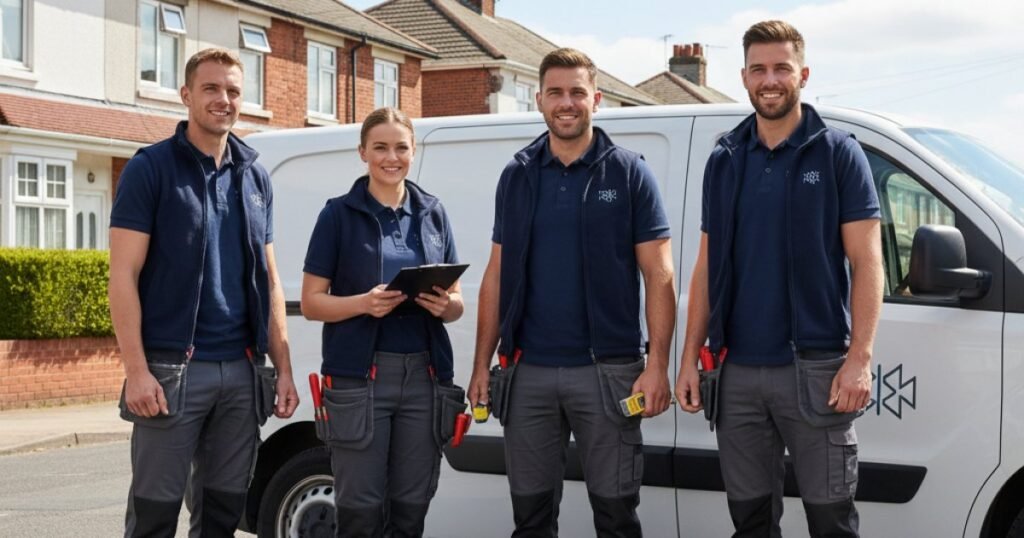
- Construction, maintenance and trades, durability is everything. Cargo trousers, fleeces, hard-wearing polo shirts and hi-vis/">custom hi-vis are usually the core. If your team are on the road or on site, hi-vis may be a legal requirement, not just an option.
- Hospitality and retail, T-shirts and aprons work well for front-of-house. For back-of-house or delivery teams, a work uniform built around branded sweatshirts or polo shirts is often the go-to.
- Healthcare, schools and care settings, tunics, polo shirts and fleece jackets with clear, washable branding are typical.
Stick to two or three core pieces to start. It’s far easier to add items later than it is to convince your team to wear a full uniform they find uncomfortable from day one.
Which brands are actually worth buying for workwear?
Not all branded garments are equal, and this is an area where buying cheap genuinely costs more in the long run. Garments from suppliers like Portwest, Beeswift, Uneek and Regatta, which we stock at Xcel, are built with consistent sizing and proper wash durability. That matters enormously when your team are putting garments through hot industrial washes, wearing them in all weathers, or kneeling on site.
A mid-range workwear polo from a reputable manufacturer will outlast two or three cheap alternatives. You’ll also find that the fabric holds decoration better: embroidery sits crisply on a well-constructed piqué, and printing adheres cleanly to a quality cotton-polyester blend. Cut-price garments often pill, fade or shrink in ways that make your logo look tatty within weeks.
Should you use embroidery or printing on a team uniform?
Both have their place, and at Xcel we do both in-house, which means we can give you an honest steer rather than pushing you towards what’s easiest for us.
| Factor | Embroidery | Printing |
|---|---|---|
| Durability | Excellent, survives repeated industrial washing | Very good on quality garments with correct care |
| Best for | Logos, names, chest badges on polo shirts, fleeces, caps | Large back prints, photographic designs, T-shirts |
| Feel | Raised, premium, tactile | Flat, can be full-colour and highly detailed |
| Complex gradients | Not ideal, works best with clean, defined shapes | Handles fine detail and gradients well |
| Typical use case | Trades, corporate, healthcare, schools | Events, hospitality, back-of-jacket branding |
For most embroidered workwear, polo shirts, fleeces, softshell jackets, embroidery is the default choice for a reason. It looks professional, it doesn’t crack or peel, and it survives the kind of treatment a workwear garment gets. If you want a large, colourful design across the back of a T-shirt, printing is the better route.
Many teams use both: embroidered chest logo on the front, printed branding on the back. That’s a completely normal brief for us to receive.
How do you collect sizes for a team uniform without it becoming a nightmare?
This is where most uniform projects lose time. Our practical advice:
- Send a simple spreadsheet to each person with columns for name, garment type and size. Give them a deadline, without one, you’ll still be chasing on the morning you need to order.
- Share a size guide from the brand you’re ordering. Sizing varies between manufacturers; someone who is a Large in one brand may be an XL in another. Most product pages include a size chart, share it.
- Build in a small buffer. On a team of ten, order one or two extra in the most common sizes. Staff change, new starters join, and having a spare polo shirt on the shelf is far cheaper than placing a rush reorder.
- If you’re unsure, order a sample garment first. We don’t have a minimum order requirement, so there’s nothing stopping you ordering a single item to check the fit before committing to the full team run.
What artwork or logo files do you need before you order?
For embroidery, a high-resolution version of your logo is the starting point, ideally a vector file (AI, EPS or PDF). We convert this into an embroidery-ready file at our end. If you only have a JPG or PNG, it’s usually workable, but the cleaner the original, the better the result.
For printing, a high-resolution file is equally important. Logos that look fine on a business card can fall apart when scaled up to a full back print.
If you don’t have a logo or need one designed, our online designer tool can help you build something basic, or get in touch and we can advise on artwork requirements.
A worked example: kitting out a small plumbing team
Say you run a five-person plumbing business. Your team works in customers’ homes and occasionally on commercial sites. Here’s how we’d typically approach this:
- Garments: Polo shirts (smart enough for customer homes), fleece jackets for winter, and hi-vis vests for any site work. We’d likely look at Portwest or Uneek for the polos and fleeces, tough, consistent sizing, good colour range.
- Decoration: Embroidered logo on the left chest of the polo and fleece. Printed company name and number on the back of the fleece for visibility on the road.
- Process: Collect sizes on a spreadsheet, share the brand size guide, order a sample polo first. Once the fit is confirmed, place the full order. Lead time from artwork approval is typically a matter of days, not weeks, for a small team run.
- Result: A team that looks consistent, professional and clearly identifiable, which builds customer trust from the moment someone opens the door.
Explore the full range of options for this kind of brief on our personalised workwear pages.
Who is this approach not right for?
To be straight with you: if you need hundreds of garments with complex, multicolour designs, several placement positions and a six-week lead time, a large national print operation with dedicated account management might suit you better from a logistics standpoint. We’re built for fast, quality turnarounds for small and medium-sized teams, that’s genuinely where we excel.
Similarly, if your entire brief is a single item with no logo, just a name on the back, a local embroiderer or high-street trophy shop may be convenient and cheap. Our value is in consistent, quality branded workwear for teams, with real flexibility on quantities.
Ready to get started?
If you know roughly what you need, the fastest next step is to get in touch with us directly. Tell us your team size, the garments you’re thinking about and what your logo looks like, and we’ll come back to you with practical options rather than a generic quote form. We’ve been doing this for over 20 years and we’d rather spend five minutes on the phone saving you a headache than have you wade through a complicated online process alone.
You can also browse our range of hoodies/">personalised hoodies and custom T-shirts if you’re building a more casual or event-focused team look alongside your core uniform.
FAQs
Is there a minimum order quantity for a team uniform?
At Xcel Print & Promotions, there is no minimum order requirement. You can order a single garment to check sizing and quality before committing to a full team run, which is something we actively recommend for new customers.
How long does it take to set up and receive a team uniform?
Once artwork is approved and sizes are confirmed, turnaround on a typical small-team order is usually a matter of days from our Haverhill workshop. Rush jobs are often possible, contact us to discuss timescales for your specific brief.
Is embroidery or printing better for workwear that gets washed frequently?
Embroidery is generally the most durable option for garments that go through repeated hot washes, as the thread is stitched directly into the fabric. Printing on quality garments with proper care instructions is also highly durable, but embroidery has the edge in heavy-use environments like construction or healthcare.
What file format do I need to provide for my logo?
A vector file (AI, EPS or PDF) is ideal for both embroidery and printing. High-resolution PNG or JPG files can work in many cases. If you're unsure, send us what you have and we'll let you know whether it's suitable or needs any work.
Can I mix embroidery and printing on the same garment?
Yes, this is a common and practical approach. A typical example is an embroidered logo on the chest combined with a printed design or text on the back. We handle both decoration methods in-house, so it's a straightforward brief for us.
Do I need to choose the same garment for my whole team, or can I mix styles?
You can mix styles, for example, polo shirts for customer-facing staff and hi-vis vests for site workers, as long as the branding is consistent. We'd recommend keeping colours and logo placement the same across garment types so the team still looks cohesive.

Written by Andy · Founder, Xcel Print & Promotions
Xcel Print & Promotions is a family-run UK workwear, branded-clothing and print company with over 20 years' experience. We embroider and print in-house from our base in Haverhill, Suffolk, with no minimum order, so this advice comes from kitting out real teams every working day, from single tradespeople to large sites and schools.
Leave a Reply