Yellow vs Orange Hi-Vis Vests: Which Should Your Team Wear?
Last reviewed: 13 October 2026 · Written and reviewed by the Xcel Print & Promotions team
Published: 13 October 2026
In the UK, both yellow and orange hi-vis vests can meet the EN ISO 20471 safety standard, but yellow is by far the most common choice for general site and roadside work, while orange is typically used where workers need to stand out from yellow road-marking equipment or in certain industry-specific environments. The right colour for your team usually comes down to your site’s risk assessment, any client or principal contractor rules, and, in some cases, sector convention. When in doubt, check your risk assessment first and ask your principal contractor second.
If you manage a team of trades, run a facilities company, or you’re putting together branded workwear for a construction crew, you’ve probably stared at a hi-vis catalogue and wondered: does the colour actually matter, or is this just a preference? The honest answer is that it matters more than most people realise, but it’s also not as complicated as some suppliers make it sound. Here’s what you genuinely need to know.
What Does UK Law Actually Say About Hi-Vis Colour?
UK health and safety law, primarily the Personal Protective Equipment at Work Regulations, doesn’t specify a colour for hi-vis clothing. What it does require is that the PPE you provide is appropriate for the risk. The relevant performance standard is EN ISO 20471, which covers high-visibility warning clothing. That standard defines three classes (Class 1, 2 and 3) based on the total area of fluorescent and retroreflective material, and it permits fluorescent yellow, fluorescent orange-red, and fluorescent red as compliant background colours.
So legally, both yellow and orange can be compliant. The question is which one is appropriate for your specific risk environment, and that’s where practical guidance matters more than a rulebook.
Why Is Yellow Hi-Vis So Dominant on UK Sites?
Walk onto any UK construction site, visit a council highways crew, or watch a utility team working a pavement and you’ll see a sea of yellow. That’s not an accident. Fluorescent yellow has the highest luminance factor of the permitted colours, meaning it reflects more daylight and is statistically easier to spot in overcast, grey British conditions, which describes most of our working year.
Yellow also became the de facto standard early in the history of hi-vis PPE, so it’s embedded in site induction rules, principal contractor requirements and client specifications across the board. If your team works across multiple sites or for different clients, yellow is almost always the safer administrative choice, you’re unlikely to be turned away at the gate.
For custom hi-vis clothing in general, yellow is what most UK businesses order, and it’s what we hold the most stock of. If you’re starting from scratch, yellow is the pragmatic default.
When Should You Choose Orange Hi-Vis?
Orange hi-vis has genuine, practical use cases, it’s not just a stylistic alternative. The key scenarios where orange makes sense include:
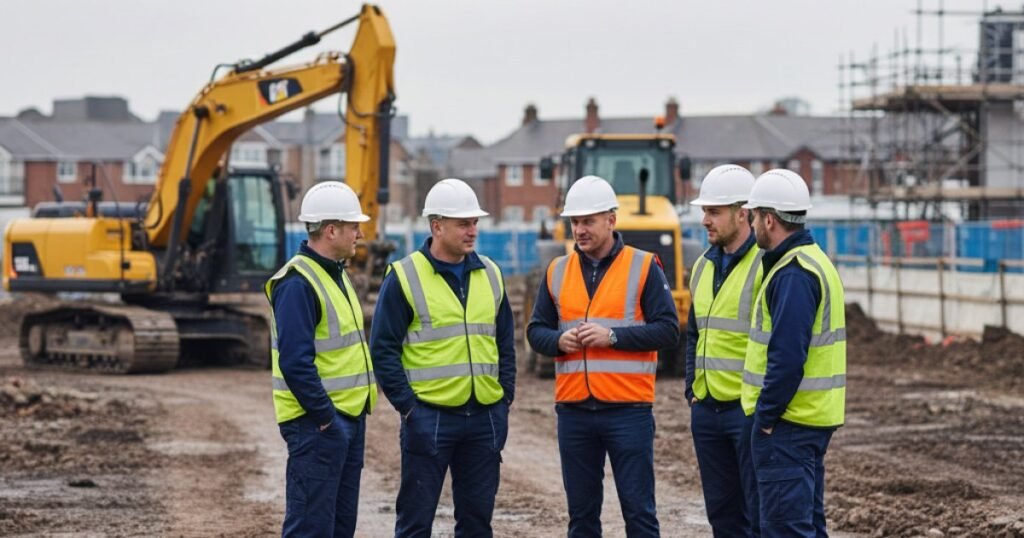
- Differentiation from yellow equipment: On sites where yellow plant, machinery or road-marking vehicles are operating, workers in yellow vests can visually merge with the background. Orange creates contrast and makes individuals stand out distinctly.
- Rail and trackside work: Network Rail and many rail contractors specify orange (often orange with blue) as their standard for trackside workers. If your crew works in this environment, orange may be mandated.
- Airports and airside operations: Many airside employers specify orange so that ground crew stand out on taxiways and aprons where yellow ground markings and vehicles are common.
- Recycling, waste and logistics: Some operators in these sectors use orange to differentiate roles, supervisors in one colour, operatives in another, particularly where teams work around yellow vehicles.
- Client or principal contractor specification: Occasionally a main contractor will specify orange for a particular package of work, so always check your pre-start documentation.
If any of the above apply to your team, orange is worth taking seriously, not as a fashion choice, but as a practical risk-control measure.
Yellow vs Orange: A Quick Comparison
| Factor | Fluorescent Yellow | Fluorescent Orange |
|---|---|---|
| EN ISO 20471 compliant? | Yes | Yes |
| Most common on UK construction sites? | Yes | Rarely (unless specified) |
| Best visibility in grey daylight? | Generally higher luminance | Good, especially against yellow backgrounds |
| Used in rail / airside? | Sometimes | Often mandated |
| Available branded / printed? | Yes, wide range | Yes, slightly fewer styles |
| Default choice if unsure? | Yes | Only if risk assessment / client requires it |
Does the Colour Affect Hi-Vis Class (1, 2 or 3)?
No, the EN ISO 20471 class is determined by the total area of fluorescent background material and retroreflective tape, not by whether the garment is yellow or orange. A Class 2 vest is a Class 2 vest regardless of colour. What matters for class selection is your risk assessment: roadside workers on live carriageways typically need Class 2 or 3; a warehouse operative working away from vehicle routes might only require Class 1. If you’re unsure, Class 2 vests are the practical standard for most outdoor trades work.
A Worked Example: Kitting Out a Mixed Groundworks Team
Imagine you run a groundworks business that works on developer sites (where yellow is the site standard) but also picks up occasional subcontract packages for a utilities contractor who specifies orange for their excavation crews. The pragmatic answer here is to hold both, yellow vests for your standard developer site work, and a smaller stock of orange for the utilities packages. Both can carry your company logo via printing, so your branding remains consistent even when the colour changes.
When we kit out teams like this at Xcel, we’ll often suggest ordering your main colour in a larger quantity and your secondary colour in a smaller run. Because we have no minimum order, you’re not forced to buy 50 orange vests if you only need 10. You can order exactly what the job requires.
For teams buying in volume, our bundle deals on printed hi-vis vests are worth a look, we offer packs of 25, 50, 100 or 250 printed vests with your logo included at a fixed price, available in both yellow and orange. It’s one of the most cost-effective ways to get a uniformed, branded site team ready quickly.
How Should You Brand Hi-Vis Vests?
Hi-vis vests are almost always branded via printing rather than embroidery. Embroidery adds weight and can affect the retroreflective tape positioning on lighter vests, and the raised texture doesn’t suit the flat mesh panels typical of budget and mid-range vests. Printing gives you a clean, flat, durable result that holds up to outdoor use and repeated washing, which is exactly what you need on a working site.
Logo placement is typically the left chest for a company name or logo, the back for larger branding or a web address. Many businesses also add a name or job role to personalise each vest. If you’re supplying artwork, send us a vector file (AI, EPS, SVG or PDF) or a high-res PNG at 1000px or wider for best results. Get in touch if you’re not sure what you have, we’ll tell you straight.
Logo digitising for embroidery is free, and printing setup is included in our pricing. Lead times for customised items are 7-10 working days and vary with demand. Plain stock ships faster. Delivery is £5.95 + VAT, free on orders over £99 ex VAT.
You can browse our full range of hi-vis clothing online, or if you need vests alongside other branded site gear, polo shirts, hoodies, fleeces, take a look at our personalised workwear options for a consistent team look.
Who This Guide Isn’t For
If your team works in a highly regulated or specialist environment, offshore, nuclear, certain rail packages or emergency services, this general guidance isn’t sufficient. Those sectors have specific standards, colour requirements and garment specifications that go beyond EN ISO 20471. In those cases, consult your safety adviser or the relevant sector body before ordering. We’re happy to produce garments to your specification, but the compliance decision needs to come from your risk assessment, not a vest supplier.
The Bottom Line
For the vast majority of UK trades, construction crews and site teams: yellow is your default, orange is for specific circumstances. Check your risk assessment, check your principal contractor’s site rules, and if there’s no specification either way, go yellow. Get them printed with your logo, order the quantity you actually need, and move on, there are bigger decisions to make before the job starts.
If you’re ready to order or want to talk through what’s right for your team, contact us here, we’ve been kitting out UK working teams for over 20 years and we’ll give you a straight answer.
FAQs
Is yellow or orange hi-vis better for UK construction sites?
Yellow is the standard on the vast majority of UK construction sites and is accepted across almost all principal contractor site rules. Orange is used in specific circumstances, such as where workers need to stand out from yellow machinery, or where a contractor specifies it. If you have no specific requirement, yellow is the safer default.
Are orange hi-vis vests EN ISO 20471 compliant?
Yes. EN ISO 20471 permits fluorescent yellow, fluorescent orange-red and fluorescent red as compliant background colours. Compliance depends on the total area of fluorescent and retroreflective material (the class), not the colour alone.
Can I get orange hi-vis vests printed with my company logo?
Yes, we print both yellow and orange hi-vis vests with company logos, names or web addresses. Send your artwork as a vector file (AI, EPS, SVG or PDF) or a high-res PNG at 1000px or wider. No minimum order is required.
How long does it take to get branded hi-vis vests?
Lead times for customised items are 7-10 working days and vary with demand. Plain stock ships faster. If you need vests in volume, our bundle deals (packs of 25, 50, 100 or 250 printed vests) include the logo at a fixed price.
Does hi-vis colour affect the EN ISO 20471 class rating?
No. The class (1, 2 or 3) is determined by the total area of fluorescent background material and retroreflective tape on the garment, not by the colour. A Class 2 orange vest and a Class 2 yellow vest offer the same rated level of visibility performance.
Why do rail workers often wear orange hi-vis instead of yellow?
Network Rail and many rail contractors specify orange (often combined with blue) for trackside workers. This helps workers stand out from yellow trackside equipment and provides a clear visual distinction that is part of their safety management system. If your team works trackside, check your principal contractor's specific requirements before ordering.

Written by Andy · Founder, Xcel Print & Promotions
Xcel Print & Promotions is a family-run UK workwear, branded-clothing and print company with over 20 years' experience. We embroider and print in-house from our base in Haverhill, Suffolk, with no minimum order, so this advice comes from kitting out real teams every working day, from single tradespeople to large sites and schools.
Leave a Reply